Selecting a fund administrator may be one of the first tasks you complete when launching a new fund, but you need to complete your due diligence to choose an administrator who can grow with you and become a partner in your fund’s success. Since fund administration encompasses mission-critical back-office tasks like fund accounting, investor support, and financial statement preparation, deciding on a fund administrator will be one of the most important decisions you’ll make when setting up or growing a fund.
Why Do Alternative Investment Firms Use a Fund Administrator?
Alternative investment firms like hedge funds, private equity, or venture capital firms use a fund administrator to outsource a host of operational functions like fund accounting, reporting, and investor services. In fact, it’s increasingly common for firms to outsource these back- and middle- office tasks to increase the operational efficiency of the front office.
Administrators help funds with critical but routine functions like investor onboarding, including compliance support and anti-money laundering (AML) and Know Your Client (KYC) checks. They monitor changes in investors’ political exposure, sanctions, or adverse news and regulatory modifications to support compliance.
They also prepare and file the most commonly required regulatory forms like SEC forms PF and 13F, National Futures Association (NFA) form PQR, FATCA/CRS, Blue Sky, and BOTA for the Cayman Islands. Most admins are familiar with global laws and regulations, and can help you expand your fund across multiple jurisdictions.
Investors, particularly large institutional investors like pension funds and universities, appreciate the independent oversight that a fund administrator provides and often will only invest in funds who partner with third-party administrators. Outsourced administrators provide another set of eyes to verify valuations and fund performance.
Roles of a Fund Administrator
Fund administrators offer economies of scale that enable them to produce superior reporting, accounting, and compliance functions for less than you’d pay an in-house team:
- Fund accounting including daily or monthly net asset value (NAV) calculations, capital call processing, loan calculations, portfolio valuation, and audit coordination
- Investor services including risk, investor onboarding, due diligence, subscriptions, capital calls and distributions, interest payment transfers; and complex tranche, multi-class, or multi-currency accounting
- Investor communications such as monthly reporting, answering investor queries, and delivering branded monthly communication from the fund
- Allocation services including allocating income and expenses to investors, automated fee calculations including waterfall structures, and producing official capital account documents
- Additional services including financial statement preparation, GP/ManCo accounting, shadow accounting, and tax services
When to Evaluate or Switch Your Fund Administrator
If you’re working with a vendor who is not meeting your expectations, or you’re considering outsourcing back-office functions currently handled in-house, here are a few indicators that a change might be beneficial.
Organic Growth Triggers
Your fund may have reached a point where your in-house team struggles to reconcile your daily trades or to keep up with the growing complexity of multi-jurisdictional reporting. Adopting more complex fund structures can cause your regulatory and tax filing responsibilities to soar. If this is the case, hiring a third-party administrator with deep institutional knowledge of complex fund strategies, regulatory know-how, and reporting infrastructure frees up your internal team to better manage your investments and grow the fund.
Operational Red Flags
Sometimes, it’s evident that you picked the wrong administrator from the start. You may have noticed clear signs it’s time to switch, like multiple errors with NAV calculations, slow month-end reporting, unreliable customer service, or investor complaints. Another red flag is a failed audit or reporting or valuation problems pointed out by your auditor.
Key Criteria for Selecting a Fund Administrator
It may be tempting to choose a fund administrator based on another fund manager’s recommendation or an internet search. However, if you want to pick an administrator who’ll meet your specific requirements and partner with you to grow your fund, make sure you ask about the following criteria during the request for proposal (RFP) process.
Asset Class and Strategy Expertise
Choose a fund administrator with expertise in your asset class and/or fund strategy. If you invest in digital assets like cryptocurrency, you need an administrator with the infrastructure to support connections to digital wallets, exchanges, and blockchains. Complex fund structures like multi-manager funds need administrators who can provide look-through reporting at the portfolio level, as well as breakdowns by strategy, asset class, and region.
Technology Infrastructure
Ideally, you’ll want to choose a fund administrator with a proprietary technology platform, preferably with a single login. Administrators with proprietary platforms can provide customized reports, features, and upgrades much faster than administrators who lease a third-party platform. You’re also less likely to pay for licensing or upgrade fees since the technology is owned in-house.
Also make sure that the admin has a robust API gateway to securely pull your data into the system.
Reporting Quality and Investor Portal
The best fund administrators offer hundreds of fund reporting templates and can support customized report requests at no additional cost. Some even offer on-demand reporting so you can pull completed reports anytime straight from the portal. Portals can be white labeled to give your investors a totally branded experience unique to your fund.
Ask potential administrators for a walk-through of their portal so you can get a feel for how user-friendly it is, and the level of customization it allows.
Regulatory and Compliance Depth
You’ll need an administrator who can handle the regulatory and tax reporting requirements of each fund’s jurisdiction, especially if you have international feeder funds. Ask potential administrators how fast their systems can adapt to regulatory changes, and whether they offer continuous monitoring for regulatory changes, so you’re not caught by surprise.
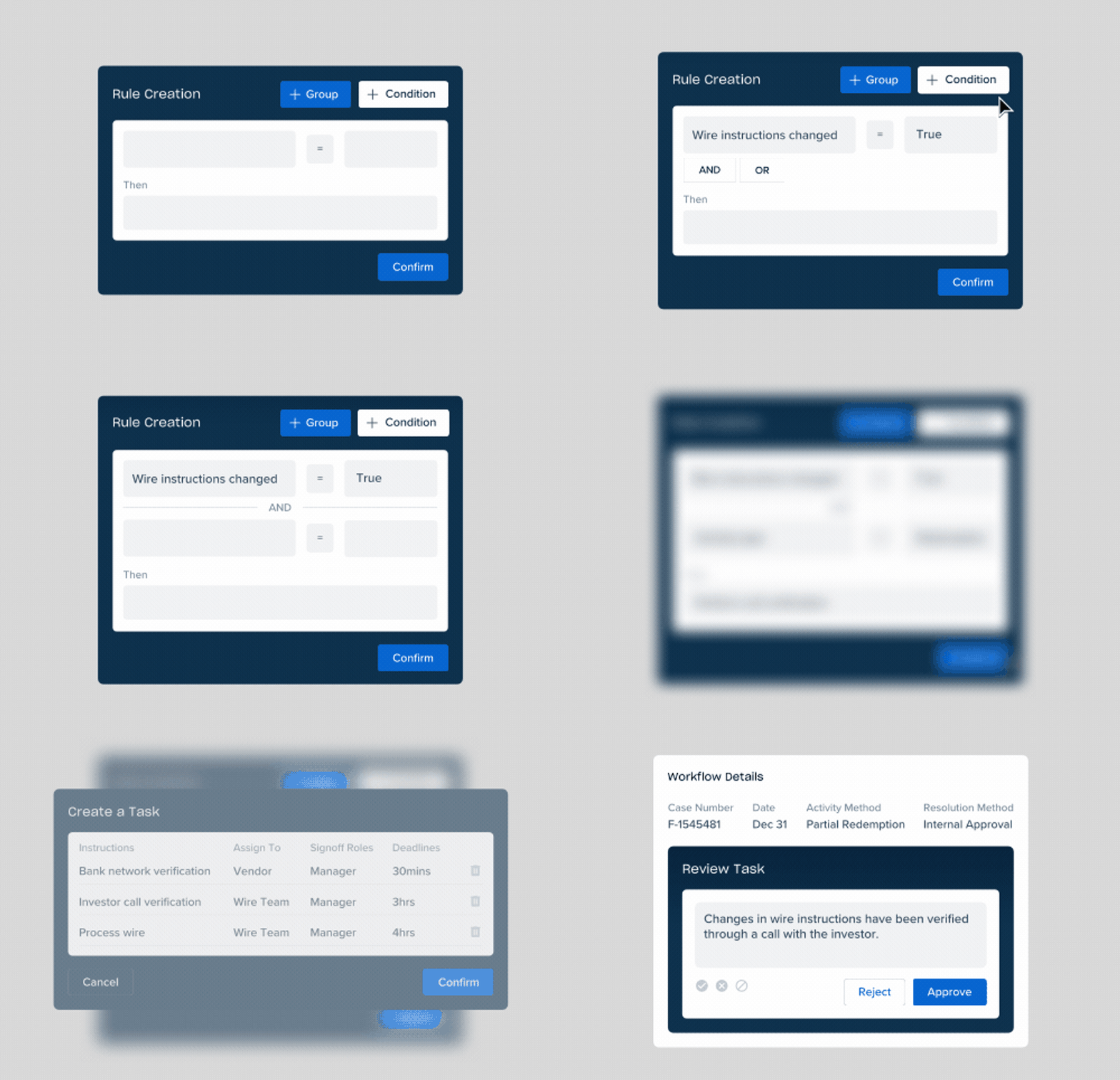
NAV’s proprietary Compliance Rule Engine enables our in-house team to write complex workflows in real time for newly introduced or revised regulations, eliminating the lag time associated with software updates.
Team Stability and Service Model
Watch out for administrators with high employee turnover. When you lose an account manager, you also lose that person’s institutional knowledge of your fund and are forced to retrain their replacement. The most reputable administrators have low turnover and client reps with years of tenure.
Look for a company that offers a service model with dedicated account representatives and backups who are available to answer questions after hours, on weekends, and on holidays. You don’t want to be left hanging if you have an urgent question.
Scalability as Your Fund Grows
Scaling your fund can introduce increasingly complex operational challenges and it’s essential that your administrator is able to keep up. As your fund grows, you will likely have to manage multi-jurisdictional compliance, additional asset classes and investment strategies, and more demanding institutional investors. Ask potential administrators about specific clients they’ve worked with who have scaled significantly, and how they addressed operational hurdles. Also check to make sure they’ve constantly maintaining and upgrading their technology platforms, to ensure they have the resources to continue to support your fund.
In-House versus Outsourced Administrators
If your fund is small, you may consider keeping your back-office functions in-house, especially if your fund accounting needs are straightforward and the team can produce reports with basic accounting software and spreadsheets. At the start, it may be cheaper to keep an in-house team, and you’ll definitely have more control and responsiveness since the team is working in the same office space.
However, as your fund grows, the in-house team will need to handle increasingly complex regulatory and compliance needs which may prove too difficult to handle in-house, especially as your technology needs become more involved. For example, the accounting team may have to reconcile data from multiple sites if you have a fund or funds with multiple asset classes or strategies.
An outsourced administrator works with hundreds, if not thousands, of clients, and likely has the economies of scale and technological know-how in place to support high-volume investor transactions, complex strategies, multiple jurisdictions, and multi-asset classes. They also likely have procedures in place to monitor frequent global regulatory changes to make sure you’re compliant.
Using a reputable fund administrator is also positive validation for potential investors, especially institutional investors, since you’ll be working with an independent source to verify valuation metrics and performance for an extra layer of oversight in line with good corporate governance policies.
The Right Fund Administrator is a Strategic Partner, Not a Vendor
A quality fund administrator provides accurate, on-time month-end NAV calculations and investor reporting, addresses any investor questions or concerns promptly, and otherwise supports your fund with well-run, professional processes and delivery. A fund administrator’s investor portal is a key point of interaction between investors and the fund, so proper branding, excellent customer support, and data rooms that allow you to market your firm and funds help you strengthen your relationship with investors.
But your administrator should offer more than just accurate and reliable back-office support. You want an administrator who will be a long-term partner, who is familiar with your fund and operations and who can provide prompt assistance and personalized service.
NAV Fund Services is a privately owned, global fund administrator who supports more than 2,500 clients at all levels, from emerging managers to funds with multibillion-dollar assets under management (AUM). From Day One, you’ll have a dedicated account team who partners with you to streamline and optimize your funds operations. We’re proud of our 99% client retention rate, a testament to our client-first mentality. Contact us for more information about our award-winning fund administration services.