Fund administrators take on many of the time intensive but critical tasks needed to run a successful fund, like net asset value (NAV) calculations, investor reporting, and regulatory filings. But increasingly, excellent administrators are also invaluable partners who bolster investor trust, manage risk, and improve the operational stability of your fund. Choosing the right administrator can mean the difference between constantly shifting your focus to operational hiccups, reporting delays, and investor concerns or a smooth back-office experience. During the request for proposal (RFP) process, consider asking each of your potential admins the following questions, so you can get a better idea of what type of experience you'll have if you hire them (if you're an emerging manager, take a look at our 10 bonus questions for emerging managers).
1. Is your fund administration service’s technology platform proprietary or leased?
The best fund administrators use proprietary technology to administer your fund, and this is important for several reasons. First, it’s cost-effective: if a firm uses an in-house proprietary system, they don’t have to pay licensing and integration fees and can pass that savings on to you. Second, it’s fundamentally more secure. You don’t have to worry about potential data breaches of confidential client data via a third-party technology partner. Third, proprietary platforms have been developed over time with clients in mind, so they’ve been tested and refined for years. Your fund administrator is more likely to be able to honor special requests and tackle complex trading scenarios with in-house technology.
Be aware that some admins may purchase technology platforms that they then pass off as proprietary. While purchasing a third-party platform may be a quicker solution and require fewer in-house resources for ongoing development and maintenance, it hasn’t been developed specifically by your administrator to best handle their clients’ specific needs.
You should also consider the integration of the technology. Will you have to log on to multiple platforms? Ideally, your admin will provide an all-in-one login to give you and your investors a unified portal experience.
2. Can you demonstrate how your technology will support my specific fund structure?
The fund administrators you’re considering should be ready to walk you through exactly how their technology platforms will support you and your investors. If an administrator doesn’t offer demos or can’t answer your technology questions, this can be a red flag.
Perhaps one of the most important aspects of a fund admin’s service offerings is the quality and accessibility of its client portal. The best fund administrators can provide customizable portals to showcase your firm’s corporate branding and offer mobile apps so investors can log on from any device at their convenience. A walk-through will show you not only how you’ll access NAV calculations, financial statements, and reporting templates, but also explain specialized features of the portal, such as sandboxes, API integrations, and e-subscriptions.
If you have a crypto or other alternative assets fund, ask your administrator candidates to demonstrate how investors will connect to an exchange or input a wallet address, as well as the security measures in place to protect that data. Likewise, if your fund has unique reporting requirements, like a private equity fund, an administrator should be able to show you features specific to your fund type.
Other considerations you’ll want to ask about: E-subscriptions enable investors to input Anti-Money Laundering (AML) and Know Your Client (KYC) data directly online — does the admin offer this service? Does the administrator offer a data room, where you can securely share information about different fund offerings with your investors? A data room can serve as an additional marketing tool. Do they offer to upload monthly reports or quarterly newsletters for you, to assist with investor communication? If so, investors can receive marketing communications at the same time they receive financial reports. How customizable is their technology? You may need specialized solutions for a unique setup or feature.
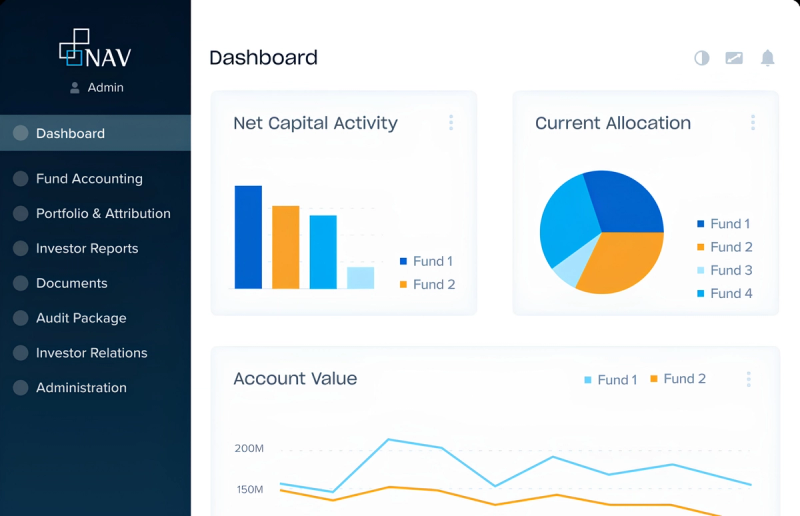
NAV Fund Services offers potential clients walk-throughs of both fund manager and client portals.
3. How many large fund transitions have you completed?
An experienced administrator will have facilitated dozens or even hundreds of large fund transitions. Transitioning a billion-dollar+ fund is much more complex than smaller fund migrations. Large fund switches typically involve transitioning investors from many different jurisdictions, and this will involve a large volume of data transfer and complex operational requirements.
A prospective admin should be able to onboard your fund with minimal disruption to your operations, automatically transitioning your investors’ compliance data, running parallel accounting to make sure they can support the current year’s audit and tax reporting, and mitigating impact to NAV calculations and investor communications. Your new fund administrator should be prepared to replicate your key reports, support your current audit year, and communicate clear timelines with investors. Top fund admins can migrate a multibillion-dollar portfolio in weeks, not months, if they have a well-established transition plan.
It’s a good sign if the administrator has received more incoming than outgoing fund migrations. You may want to request that prospective administrators share client stories or references of funds that have transitioned to them from another fund administrator.
4. Who will be our servicing team, and will that team stay consistent?
When you’re choosing a fund administrator, you want to make sure that you’ll receive consistent, quality customer service. Ideally, you’ll want one or more named account representatives assigned to your account and the ability to contact someone from the company around the clock with questions or concerns. Also ask about staff turnover. If there’s a high staff turnover rate, that will affect your team’s service.
For emerging managers, consider choosing an administrator who specializes in emerging funds. Administrators who’ve worked with lots of emerging funds understand the complexities of launching a fund and can provide valuable recommendations on any operational questions you might have. They’ll also often wait to bill you until you go live.
Some fund administrators offer services or even packages specifically for emerging funds, but they’re not necessarily designed to scale with your fund and service quality may drop as your fund grows. If you’re an emerging fund, make sure you’ll have access to a knowledgeable, dedicated account representative from the start and throughout your fund’s lifecycle.
5. What compliance, AML, KYC, and regulatory support do you provide?
A good compliance partner can make or break your firm, because they handle investor reporting, meet compliance deadlines, and provide operational accuracy.
Full-service administrators offer onboarding services to fulfill AML and KYC requirements quickly and conveniently for your investors. They also monitor regulatory changes and make sure clients are informed about and up-to-date with new or changing regulations to remain compliant. The top fund administrators have systems in place that are updated when regulatory changes occur to proactively support accurate and timely compliance.
Regulatory requirements for different regions and funds vary widely. A hedge fund located within the United States may require Form PF filings, while a hedge fund in Europe could be subject to AIFMD Annex IV reporting. Ask administrators how their compliance history tracks to your specific regulatory requirements. An administrator with broad regional experience will reduce compliance risks and unnecessary expenses.
As AI-generated identity fraud grows, some administrators now verify onboarding media (selfies, ID scans, liveness checks) as a second layer beyond standard KYC.
6. How do you charge for administration services? Will your fees change based on the size of my fund?
A reputable fund administrator should provide a straightforward, transparent pricing model that clearly states what services are included and what you’ll pay extra for. Will the admin charge you for updates to its technology platform? Are you charged by the investor or a flat fee for add-on services? You don’t want to be nickel-and-dimed by your administrator for every additional service.
Many smaller funds may start with only a few services — like fund accounting, reporting, and investor screening — before adding additional services like draft financial statements or tax services. Will you be able to choose from a menu of available services and pay accordingly, or will you be required to sign on for a comprehensive package that includes services you may not need until your fund’s investor base and AUM grow?
Keep in mind that fee structures are likely to vary based on type of fund. Fund administrators typically charge a percentage of AUM for hedge funds, a percentage which commonly decreases as your fund grows. For PE, venture capital, and real estate funds, or other closed-end funds, many admins use a fixed fee model, normally charged quarterly as a percentage of committed capital.
7. What is your turnaround time for capital calls, distributions, NAVs, and investor reports?
Fund administrators should be able to tell you exactly how long turnaround times run for common functions like capital calls, K-1s, NAV reporting, monthly investor statements, etc. They should be able to clearly communicate what you’ll need to provide in order for them to accurately and timely deliver — whether that’s greenlighting monthly NAV calculations or giving your bank the go-ahead for distributions.
You want a fund administrator who’s not only timely, but accurate. Ask about the systems they have in place to double check calculations, course correct if there are errors, and handle follow-ups for late capital call payments.
8. How do you format investor reports?
Well-administered funds offer clean quarterly reporting packages with full performance metrics, capital account detail, and portfolio information. Request and examine an administrator’s sample investor reports, and ask about customizable reports and if you’ll be charged a fee to create them. Also ask about possible delivery methods for reports (via a portal, secure file transfer, or email). Your administrator should allow you to automate reports for different recipients, like managers, investors, and auditors.
Because your investors may evaluate your fund based on the quality of reporting they receive, it’s important that you can rely on the design, accuracy, and timeliness of these reports.
9. What expertise do you have with digital assets and alternative funds?
Not all fund administrators provide digital asset fund administration, but as traditional funds increasingly offer tokenized funds or digital alternatives, it’s a smart strategy to choose an administrator with experience in this area. If you deal with blockchain transactions in any way, unique situations will constantly pop up, and you’ll want a digital asset fund administrator who has the systems and the know-how to handle them.
Ask the administrator how many digital asset funds they currently support. Can they integrate with crypto exchanges and blockchains? Can they clearly explain how NAV calculations and reporting work for these funds? You should also inquire about what types of digital strategies the administrator supports.
Another issue is compliance. An administrator experienced in digital assets can provide help with regulatory filings and review offering documents, among other services.
10. Can you provide references from current clients with similar fund structures?
A potential fund administrator should willingly provide multiple references for clients with similar fund structures and jurisdictions. Talking to an administrator’s clients gives you the opportunity to ask pointed questions and will give you a better feel for an administrator’s attention to detail and responsiveness.
Clients can also share issues that have cropped up and how the administrator responded — this can help you understand the firm’s level of support and the resilience of its operational infrastructure.
Why It’s So Important to Make the Right Choice in a Fund Admin
Subpar fund administration can absolutely contribute to poor fund performance. If you’re spending your time addressing operational issues and investor questions because of an unreliable administrator, that leaves less room in your schedule that could be more profitably spent analyzing fund performance or attracting new capital.
Plus, investors who routinely receive inaccurate or late reporting or need to repeatedly request information regarding capital call distributions, compliance filings, or investor agreements may become frustrated, question your fund’s stability and professionalism, and decide to invest their funds elsewhere.
Superior fund administration keeps your operations running smoothly, your investors satisfied and well-informed, and gives you the peace of mind and latitude to focus on building and nurturing successful fund performance.