NAV’s API Capabilities: Faster, Meaningful, Secure Data for Your Fund
September 21, 2026 | 12-minute read
Robust and accurate data is the cornerstone of reliable analytics. Without strong data, fund managers and COOs can’t manage their funds in real time.
NAV Fund Services is well known for state-of-the-art proprietary technology. What’s talked about less are our application programming interfaces (APIs), which enable fund managers to securely pull granular data from a variety of REST endpoints via the NAV API Gateway. As of August 2026, NAV has supported more than 120 million gateway requests. APIs help automate reporting, reduce manual work, and provide programmatic visibility into fund activity, performance, balances, and accounting information.
We recently launched a major API integration project with Northern Trust and are inthe process of testing and launching API deployments with several additional major U.S. banks. This initiative delivers real-time access to banking data and payment capabilities, and we are working to speed up turnaround times by leveraging these integrations.
We’ve also just launched an MCP server that will allow you to add our APIs to your agentic workflows.
What does all of this mean for your fund? Data produced over the course of a day moves through the API system: we provide outgoing client data from our gateway; make outgoing payments; and receive incoming data from banks, brokers, and exchanges, adding the accounting context. NAV is committed to delivering governed, real-time, meaningful data at scale so you have the most current information available to make decisions, not yesterday’s numbers.
Data Going Out: NAV API Gateway
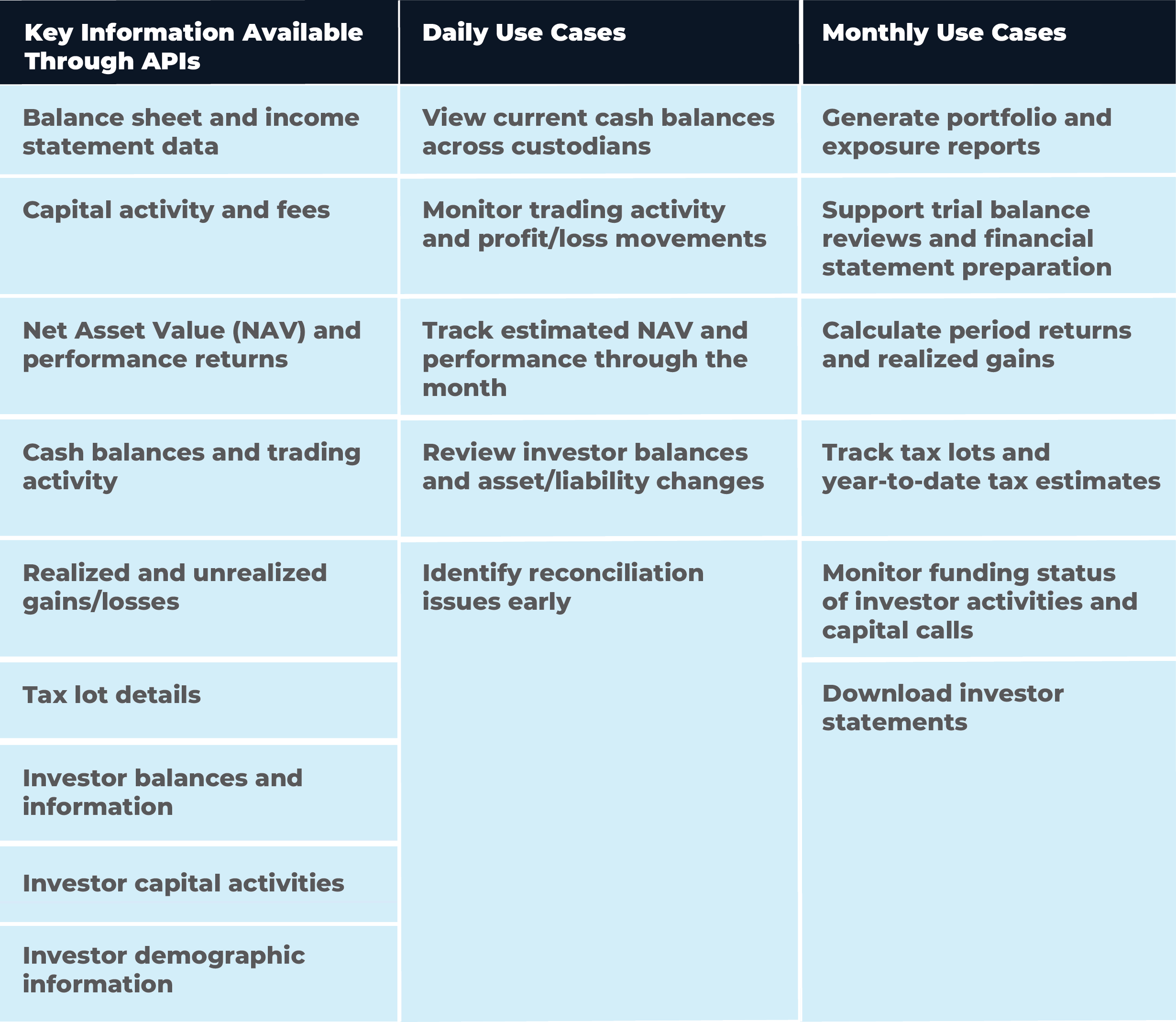
With outgoing APIs, clients can pull investor-level, fund accounting, and portfolio data from NAV systems, which is available instantly and with a level of detail that supports deeper analysis, like realized and unrealized gains and losses, tax lot details, and capital activity and fees.
Many large clients with multiple funds and hundreds or even thousands of investors prefer to fetch data via API. They want to access data instantly and programmatically. These clients manage such large amounts of data it’s not feasible to use Excel. The data is ultimately used to maintain data warehouses, run risk analytics, update CRM records, or build their own front ends using NAV data as the source of record. We have created rate limits for each endpoint, allowing clients to distribute what they need without compromising platform stability.
Building the infrastructure that supported such huge chunks of data was not easy. We needed to create interfaces in which data quality was maintained, but also simultaneously provided resilience, reliability, and stability. We also continually enhance our systems to make sure we can provide the type of data clients want to access and accommodate the number of gateway requests we support, which increases exponentially year over year.
"NAV's team consistently provides timely and accurate reporting that integrates well with our internal processes, enabling our staff to focus more on analytical tasks. Their technology infrastructure is solid and adaptable, and their client service has been consistently responsive since onboarding."
Fund Operation Manager at Longqi Scientific Investment
Here are some of the features we offer because our API runs at such a large scale:
Scoped API keys: You can restrict or limit API access by fund or data type, so third-party providers (like risk analysts or CRMs) can pull performance data without accessing investors’ personal information.
Developer guide: Access comprehensive code samples and FAQs, built from our experience with past client implementations.
Hands-on support: If you need help troubleshooting connectivity issues, we offer direct assistance through our team of 400+ IT professionals.
Error logs: If you’re pulling daily data for hundreds of funds you need to know right away if even one fetch fails, because incomplete data can cause errors or delays.
Sandbox with dummy data: For pre-go-live testing, or for clients who hire an outside developer and need to restrict access to live investor records, we can provide dummy data to test code directly or through a third party.
"Getting the statement data in a structured format makes it very easy to have concise data pipelines that 1) capture your statements, and 2) get it into our internal format."
Head of Engineering, Double River Investments
Where AI Fits In
NAV’s MCP server, which was launched this month, is an add-on feature to our existing API capabilities, supporting interaction between our APIs and LLMs like Claude and ChatGPT to help you analyze and format data in a way that’s most meaningful to you.
For emerging managers who may not currently use our APIs, the MCP server will enable you to automatically pull data without having previous coding knowledge, while providing LLMs with better context and understanding of the data fetched. Possible use cases for the MCP server include creating customized presentations, ad hoc reports, graphs, or flexible analysis of data fetched from NAV. You can schedule reports to run on a daily or weekly basis, or connect data to your own tools and communication platforms.
Outgoing Payments: Wire Initiation Through Banking APIs
Before our implementation of banking APIs, the process to send payments and wires to banks involved clients requesting that NAV fill out their bank’s wire template form, waiting for an email indicating that the wire was ready, and then logging in to their bank to approve it. In addition to the time required — often a minimum of one to two hours — the process posed security issues. Text files could be manipulated. Access controls, inherent to files moving between systems, were limited. Clients also had to monitor their email and be available to approve the transactions, remembering each bank login and password.
The API system eliminates those security concerns. With an API, there’s no file. It’s fully secure, fully permissioned, has role-based access, and is delivered to the bank seamlessly. Now, NAV initiates wires in the portal, the client approves it, also in the portal, and it’s sent — all within minutes. We can even enable a dual review if a client requires two reviewers. They can see the accounting details and monitor the status of multiple wires in one view.
Clients can also initiate wires in the portal. To make the process faster and safer, these requests can be set up for support by our automated review system. If the wire meets certain defined criteria (for example, it’s sent to a whitelisted broker and below a certain dollar threshold), the wire is auto-reviewed and the entire process is completed in one or two minutes.
Let’s say you receive a subscription and want to make a broker transfer to wire that money from your bank account to the broker. With API functionality, you can complete the transaction in just a few minutes, improving overall operations through faster fund deployment.
One thing that’s important to note: initiating payments with an API is inherently at higher risk than simply fetching data with an API. That’s why our projects to build banking integrations took substantially more development and testing time than establishing exchange and broker connections.
Incoming Data: Banks, Brokers, and Exchanges
The data we receive from banks, exchanges, and prime brokers provide balances, capital activity, trading activity, and fees. We receive payloads from hundreds of sources and each provides key information.
Before banking API connectivity, data was fetched the next day. For example, May 10 data would be posted the night of May 11. The data was not only slow, it was stale. And if transactions were missing, you had to re-download the file multiple times to see if new data was added that filled in the gaps.
With banking APIs, we can now fetch data very close to real time — in as little as just a few minutes, depending on the counterparty. Because we’ve been working closely with multiple large banks to create API systems, most clients who log into the NAV portal are able to fetch live data, including cash balances and capital call payments. For example, a private equity fund that’s called capital can immediately see which investors have paid the call instead of having to rely on yesterday’s data.
While you could always log into your bank account and see real-time account data, the benefit of NAV’s portal is the accounting detail — which investors paid, if they paid the full amount, and whether a payment is interest or income. NAV provides the context to understand the specific accounting behind each transaction. Also, if you bank with multiple banks, you no longer have to log in to separate portals. All of your fund data is visible via the NAV portal, in one central location.
We’ve also created individual connectivity for each banking integration, which means governed, highly secure data. We developed our banking integrations to meet the high enterprise cybersecurity requirements of banks, based on the state-of-the-art security used in crypto exchange integrations.
If your fund has a digital asset strategy, API connectivity is required. NAV is currently dominant in this space, administering 35% of the digital funds in the industry and offering connectivity to more than 170 exchanges and 200+ blockchains.
When we began to work with digital assets, we evaluated third-party API providers, given the sheer scale of connections required. Ultimately, though, we developed all of our integrations in house. We have built bespoke connections for a range of differing counterparties, normalizing and standardizing that data across all integrations to flow into our accounting system, so that data across exchanges can easily be compared. Despite the fact that it was a massive investment in resources for us to build individual connectivity, each API integration is proprietary and unique.
Now, we can quickly integrate with new exchanges — there’s no need to ask a software vendor to add an exchange to their development queue based on their priority. Since the tech is proprietary, we can build and adjust integrations on the fly. We offer a crypto vault where clients can easily add their API keys in a secure fashion, and our infrastructure is highly scalable, calling thousands of accounts at hundreds of exchanges without losing latency.
Given the benefits of faster API data we’ve seen with crypto exchanges and banks, NAV is currently working to build API connectivity with brokers as well. While we typically receive broker data on a T+1 basis, with APIs we can fetch data intraday, even multiple times a day.
In the past, delays in receiving broker files, rather than the NAV team’s calculation speed, was the biggest bottleneck to delivering daily NAV calculations to clients on a timely basis. We have seen measurably faster data input with our APIs from crypto exchanges, which has led to a much faster start to our daily NAV processing. With that in mind, we are integrating with certain brokers who currently have APIs, and working to collaborate on API development with others so non-digital assets clients can also enjoy the benefits of faster daily processing.
We Develop Technology the Right Way—So It Works
NAV is committed to creating cutting-edge technology for our clients, with just one of the latest examples being our large-scale API development project. We’ve done the work to build API connections with banks, brokers, and exchanges, investing the time and effort to get the technology right.
The result? Proprietary API endpoints that provide governed, real-time, and meaningful data that give you the power to make informed and timely decisions about your fund’s strategy and direction.